



News
Brussels, 16 October 2026
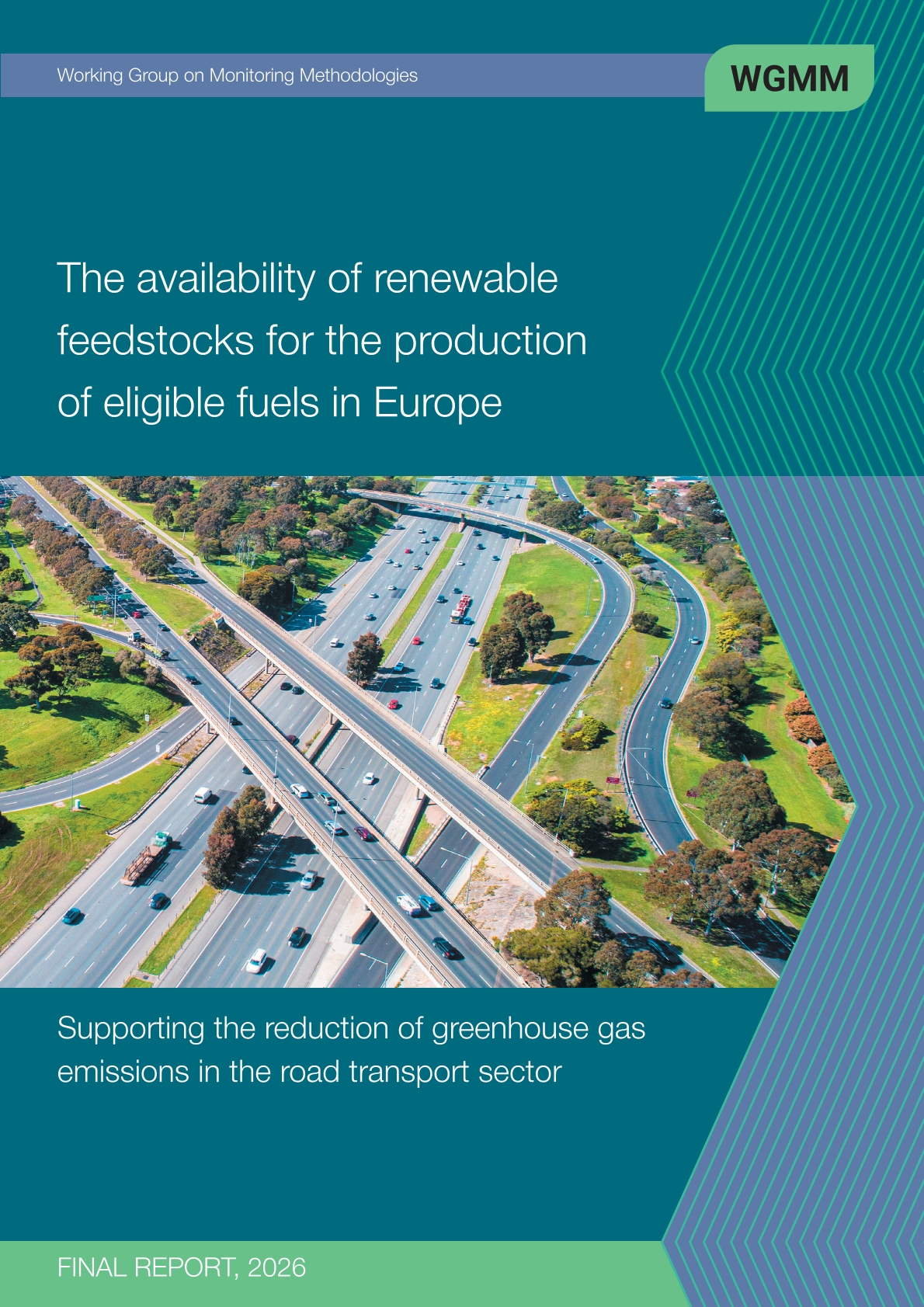
The Working Group on Monitoring Methodologies (WGMM) has published the full version of its report on The availability of renewable feedstocks for the production of eligible fuels in Europe – Supporting the reduction of greenhouse gas emissions in the road transport sector. The report builds on the WGMM’s 2024 work on a technology-neutral definition of eligible fuels and assesses whether Europe’s renewable feedstock base can support road transport decarbonisation through 2050.
To present the findings, the WGMM held a webinar on the same day. Around 120 participants joined, including representatives of the European Commission, among them DG CLIMA and DG RTD, which underlines the interest in how renewable feedstocks can contribute to the decarbonisation of road transport.
Sufficient feedstock for road transport, with synergies across modes
The report finds that Europe has sufficient renewable feedstock to underpin a robust portfolio of renewable fuels for road transport, provided that enabling conditions are in place. Estimated total renewable fuel supply potential for EU transport amounts to 238.8 to 386 Mtoe in 2050, compared with projected demand of 80 to 170 Mtoe across the scenarios assessed.
The report also highlights synergies between sustainable aviation fuel (SAF) and road transport. Plants producing SAF and e-SAF via HEFA and Power-to-Liquids/Fischer-Tropsch processes co-produce road-suitable naphtha, bio-LPG and renewable diesel (HVO). Using these co-products in road transport does not reduce the fuel available for aviation, and can help to lower the production costs of SAF and e-SAF.
The main challenge is mobilisation, not availability
According to the report, the central challenge is not the existence of feedstock, but the degree to which it can be mobilised and the cost-effectiveness of collection, transport and processing systems. The report also points to the fragmentation of feedstock requirements across transport sectors as a source of uncertainty and a barrier to investment. Stable regulatory frameworks, certification guidelines for newly integrated feedstock categories under the revised Annex IX of the Renewable Energy Directive (RED III), and the integration of eligible fuels into existing retail infrastructure are identified as key enablers.
Webinar: Authors present their findings chapter by chapter
At the webinar on 16 October 2026, the findings were presented in the same structure as the report. Eric Woydte, Chair of the WGMM Steering Group, opened the event. Mats Hultman, Co-Chair of the WGMM Technical Subgroup, then presented the objectives and key findings of the report. His main messages were that Europe could potentially have enough renewable feedstock to supply road, maritime and aviation transport simultaneously, and that renewable fuels and battery-electric vehicles are complementary. Battery-electric vehicles will not account for 100% of light- or heavy-duty vehicles, and it is better for climate that the remaining non-battery-electric vehicles run on renewable rather than fossil fuels.
The core of the programme was the presentation of each chapter by its authors. Renewable fuels for diesel engines (HVO and FAME), bio-LPG and bio-DME, bioethanol, biomethane and e-methane, and RFNBOs/e-fuels were each presented by the experts who developed the respective findings. This gave participants direct access to the underlying analysis and the opportunity to discuss it with the people who produced it.
The session concluded with a Q&A and closing remarks. The high level of participation and the engagement during the discussion show the strong interest in renewable fuels as part of the European road transport decarbonisation strategy.
Our 2026 Full Report on Feedstock Availability
Europe has sufficient renewable feedstock to supply eligible fuels for road transport through 2050. The final report sets out the findings on feedstock types, supply potential and the synergies with aviation and maritime fuels.