



News
Brussels, 13 January, 2026
Europe Has Sufficient Renewable Feedstock Potential to Produce Eligible Fuels for Road, Aviation and Maritime Transport
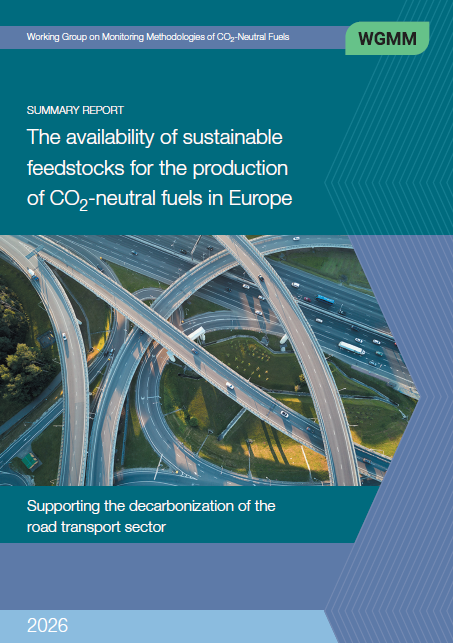
The Working Group on Monitoring Methodologies (WGMM) has finalised a new report on the availability of sustainable feedstocks for eligible fuels in Europe. Building on its 2024 work on a technology-neutral definition of eligible fuels and their role in complementing battery electric and hydrogenpowered vehicles, the 2025 summary report assesses how Europe’s renewable feedstock base can support the decarbonisation of road transport. It has found that even when renewable fuels are deployed at scale in aviation and maritime transport, sustainable feedstock potential remains sufficient to supply eligible fuels for cars and trucks in Europe.
The report draws on different analyses to quantify sustainable biomass and renewable fuel potential to 2050. It shows that agricultural and forestry residues form the backbone of Europe’s biomass potential, with biowastes and other feedstocks providing an additional resource base. The 2024 update of Annex IX of the Renewable Energy Directive (RED III), which brings intermediate crops and crops grown on severely degraded land into scope, further increases the theoretical potential for sustainable biofuel production. On this basis, the report concludes that Europe could have a broad and resilient feedstock base for the production of renewable liquid and gaseous fuels across all transport modes.
For advanced and waste-based biofuels, the studies indicated a potential of up to 79 million tonnes of oil equivalent (Mtoe) by 2030, rising to around 137 Mtoe by 2050 after accounting for demand from nontransport sectors. Conventional biofuels, produced from crops in line with RED III criteria, could provide around 15 Mtoe in 2030 and 28 Mtoe in 2050, based on European production capacities and imports through trade agreements. When these resources are combined with other renewable options – including RFNBOs/e-fuels, renewable liquid gases, and renewable methane – the report estimates a total renewable fuel supply potential for EU transport of 238.8 to 386 Mtoe in 2050. In comparison, projected renewable fuel demand for transport lies between 80 and 170 Mtoe, under several scenarios in which renewable fuels are deployed to varied degrees for the transport sector.
The report also highlights important synergies between sustainable aviation fuel (SAF) production and road transport fuels. Facilities using hydroprocessed esters and fatty acids (HEFA) and power-to-liquids/Fischer-Tropsch processes to produce SAF and eSAF co-produce roadsuitable diesel, naphtha and LPG in significant shares of total output. These co-products can be used in light and heavy-duty road vehicles without reducing the fuel available for aviation, while their valorisation in the road sector could support a faster rollout of SAF.
The WGMM summary report concludes that Europe’s sustainable feedstock base is broad and sufficient to support a significant scaling up of eligible fuels for road transport through to 2050, alongside continued growth in renewable fuels for aviation and maritime. The main challenges now lies in mobilising these resources cost-effectively through investment in collection, transport and processing systems, and in ensuring that EU and national Member States’ legislations fully recognise the contribution of all fuel pathways that meet robust environmental criteria.
Our 2025/2026 Summary Report on Feedstock Availability
Europe’s sustainable feedstock base could be sufficient to supply eligible fuels for all transport modes. This summary report outlines key findings on feedstock types, potential supply up to 2050, and the synergies between road, aviation, and maritime fuel decarbonisation.